Creating environments that work for everyone
The built environment has the potential to include or exclude people from participating fully in society. Every aspect of the built environment influences how people experience daily life. From accessing education and employment to attending medical appointments or socialising, every design decision matters.
The way buildings, streets and public spaces are designed can either enable participation or create barriers. This highlights the importance of Universal Design in shaping our communities.
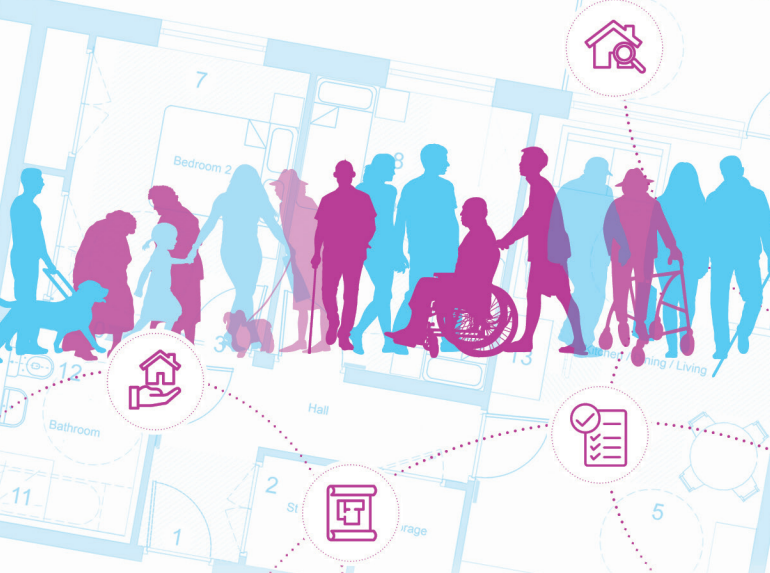
Universal Design focuses on creating environments based on the experiences of the people who use them.
When we design with Universal Design in mind, human diversity is placed at the heart of this process. It recognises that we are all different, and assumes that all of us, at some point in our lives will experience some form of disability, whether temporary of permanent.
By considering a wide range of needs from the outset, we can ensure that buildings and environments are designed to meet the needs of all users.
Planning for a changing population
Ireland, like many other countries, is facing a significant demographic shift. Based on our most recent Census data, it is projected that the older population (those aged 65 years and older) will increase from 15.1% to between 27.8% and 31.6% of the total population by the year 2057.
Furthermore, a report by the Housing Commission, that was based on the Census 2022 data, showed us that the prevalence of disability increases significantly with aging. This indicates that there will be significantly higher numbers of disabled people over the coming decades.
This demographic change will have far reaching implications on the needs of homes, public spaces, transport systems and community facilities. Universal Design provides a proactive approach to meeting these changing needs by designing to support people and families throughout different stages of life.
Going beyond minimum standards
Universal Design goes beyond meeting minimum regulations, and aims for good practice, recognising the minimum requirement, but going beyond it.
Features such as:
- step-free access,
- intuitive wayfinding,
- good lighting and visual contrast,
- clear signage, and
- adequate space
improve usability for everyone.
At its best, Universal Design is invisible, and these features are incorporated seamlessly into the design from the outset, creating barrier-free access as a norm.
Join us at UD26
Discover how architects, planners, policymakers and universal design experts are creating more accessible places and spaces. Explore examples of Universal Design in the built environment at UD26, the 8th International Design Conference, taking place in Galway City from 4-6 November 2026.
Learn more about UD26
Universal Design in the home
In housing Universal Design aims to provide homes with adequate space for people to move about safely and comfortably. It also includes providing layouts that can support future adaptations as people’s needs change throughout their lives. For example, by providing a bathroom next to a double bedroom, will ensure that an en-suite can be provided if and when it is needed.
Creating communities for everyone
By embedding Universal Design principles into the design of the built environment, we can help ensure that people can remain active, independent and connected to their communities for longer. This can reduce the need for wasteful and costly adaptations in the future.
Universal Design in the built environment will be explored throughout the 8th International Universal Design Conference (UD26).
Go to our conference event page to find out more information about the conference.