Universal Design in a changing world
Universal Design has long challenged designers to think beyond the "typical" user. It promotes the creation of products, services and environments that can be accessed, understood and used by the widest range of people possible.
Through human-centred design approaches, empathy, participation and lived experience have become central to the design process, helping to create more inclusive outcomes.
In recent years, design thinking has gained significant attention as a driver of innovation and a valuable tool for navigating an increasingly volatile and complex world.
The rise of human-centred design
The human-centred design approaches popularised by organisations such as Stanford Design School and IDEO emerged from a simple principle: putting people at the centre of design leads to solutions that are more useful, usable and widely adopted.
This approach encourages designers to engage directly with users, gather feedback and continuously refine their work.
Successful designs are often evaluated against three considerations that support long-term success:
Desirability
Do people want to use this design?
Feasibility
What is technically possible to design in the near future?
Viability
Can the design be sustained through a long-term business model?
Together, these considerations help ensure that products and services remain relevant and effective over time.
Rethinking sustainability
Within design, sustainability is often understood as durability: the ability of a product, service or organisation to continue delivering value over the long term.
However, sustainability has a broader meaning. It also refers to supporting the long-term wellbeing of both people and the planet through environmentally responsible, socially equitable and economically viable solutions.
While these definitions are related, they are not interchangeable. A product may be commercially successful while contributing to environmental harm. Equally, an environmentally responsible solution may struggle to be successful if people cannot readily access or use it.
Why sustainable design matters more than ever
Designers today face challenges that extend far beyond usability. Climate change, biodiversity loss, resource depletion and widening social inequalities are reshaping how we think about the future.
These challenges do not affect everyone equally. Disabled people and other marginalised communities often experience the greatest impacts from environmental change. Extreme weather events, poor air quality and energy poverty can restrict access to essential services and increase vulnerability.
As a result, climate adaptation, mitigation and resilience planning must explicitly consider accessibility and inclusion. Environmental sustainability and social equity cannot be treated as separate goals.
Explore these ideas at UD26
The conversation around inclusive and sustainable design is becoming increasingly important. The 8th International Universal Design Conference (UD26) will explore how Universal Design can help shape futures that work for both people and the planet.
Galway City, Ireland | 4-6 November 2026
Learn more about UD26
Beyond human-centred design
Human-centred design remains fundamental to Universal Design. However, focusing exclusively on human needs can sometimes overlook the ecological systems that support human wellbeing.
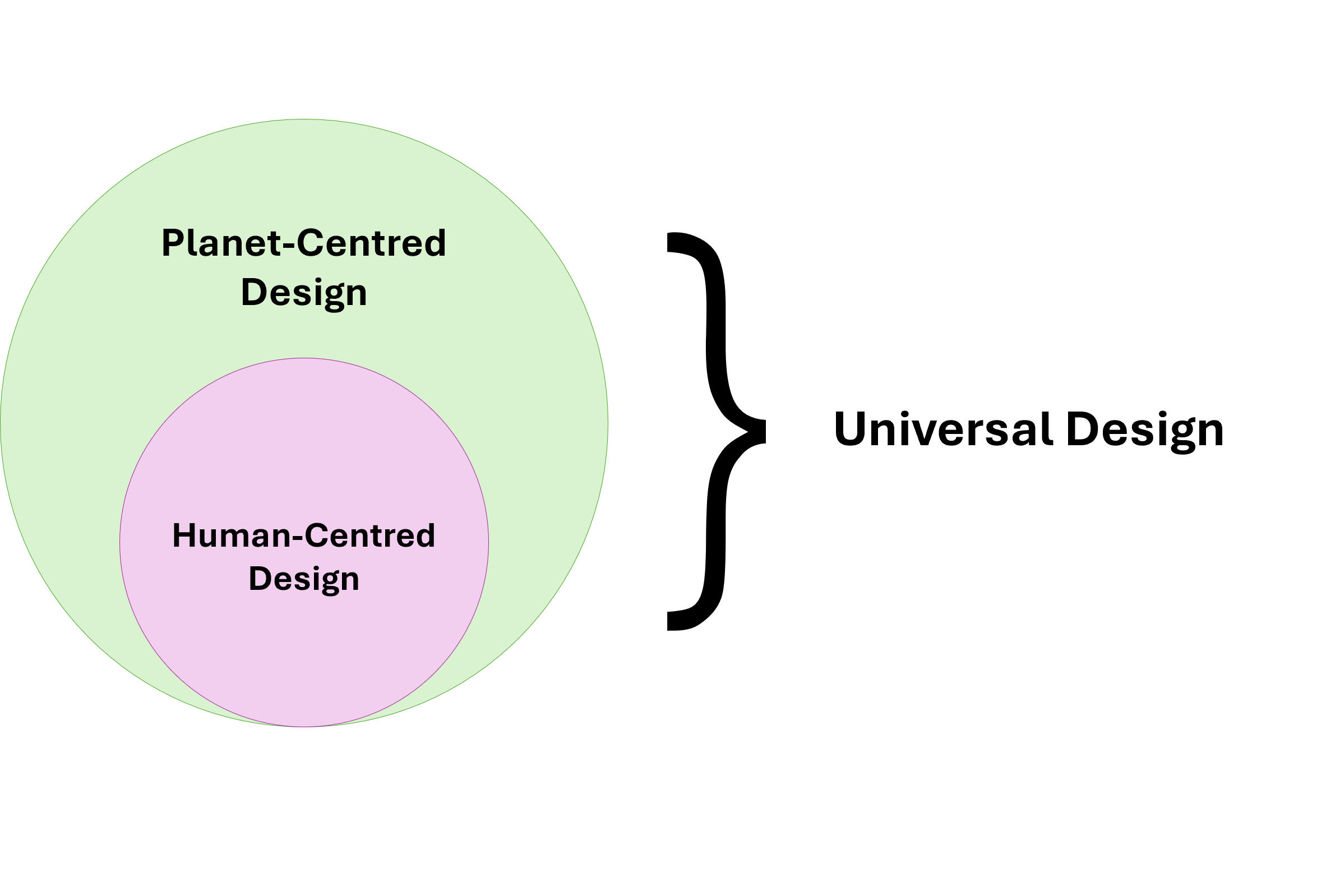
Emerging research is therefore advocating for broader approaches, including Earth-centred, life-centred and planet-centred design. These frameworks do not replace human-centred design. Rather, they recognise that people exist within interconnected social and ecological systems.
In this context, designing for people also means designing for healthy environments, resilient communities and thriving ecosystems.
Universal Design's opportunity
For Universal Design, this shift represents an opportunity rather than a departure.
Universal Design already encourages systems thinking by considering the relationships between people, products, services and environments. Extending that perspective to include planetary health is a natural evolution.
Protecting the environment contributes to cleaner air, safer communities and healthier ecosystems, all of which support accessibility, participation and quality of life. Embedding Universal Design principles into environmental planning can help ensure that both human and ecological wellbeing are considered together.
Designing the future
Accessibility, inclusion and sustainability are often discussed as separate priorities. Increasingly, however, they should be viewed as complementary goals.
As we look towards a more sustainable future, the question for designers may expand from "Who are we designing for?" to "What kind of future are we designing towards?"
Universal Design can help us answer both.
Continue the conversation at UD26
As designers increasingly consider not only who they are designing for but also what kind of future they are designing towards, these conversations are becoming more important than ever.
Join the international Universal Design community in Galway City, Ireland from 4-6 November 2026.
Go to our conference event page to find out more about UD26.
You may also be interested in our article on why Universal Design matters in the built environment, another topic that will be explored at UD26.
Further reading
• The Principles of Universal Design, Centre for Universal Design, NC State University
• Our Common Future (Brundtland Report), World Commission on Environment and Development
• EarthXDesign for a Sustainable World, Harvard Graduate School of Education
• Wicked Ethics in Design, Jason Hobbs and Terence Fenn
• From Human-Centred to Life-Centred Design, International Journal of Human-Computer Studies